
Afghanistan | Swiss Update and Statistics (2017)
Update made on the occasion of the publication of the graphic novel report Testimony of a young Afghan. From Afghanistan to Switzerland published in three episodes in the journal Vivre Ensemble in 2018 in the June issues (VE 168), September (VE 169) and December (VE 170).
[caption id="attachment_50785" align="alignright" width="254"]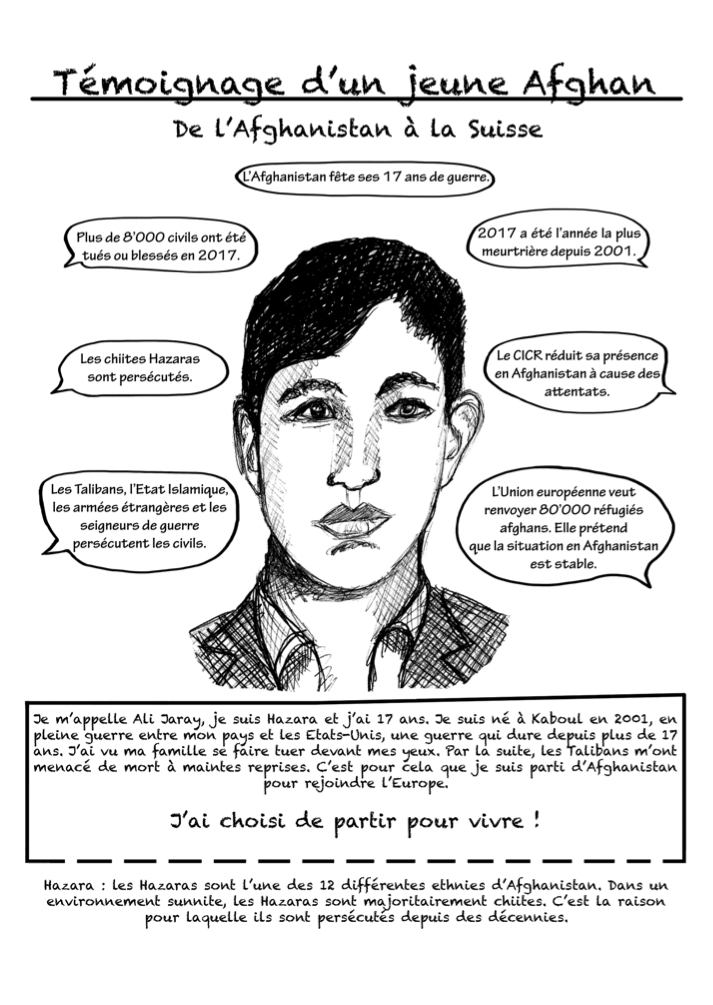 Illustrated chronicle signed Olivia Zufferey
Socio-demographic data
Capital: Kabul
President: Ashraf Ghani
Head of government: Abdullah Abdullah Population: 31.6 million (BBC, 2018)
Official languages: Dari and Pashtu (two national languages), Turkic languages (Uzbeki, Turkmen), and other minority languages (Aimaq, Ashkun, Baluchi, Gujari, Hazaragi, Kazakh and Moghili, Pashai, Nuristani, Pamiri (Alsana))
Religions: Islam (Sunni, 85% and Shia, 15%); others (Sikhism, Hinduism, Judaism)
Ethnic groups: Pashtun (42,100), Tajik (27,100), Hazara (9,100), Uzbek (9,100), Turkmen (3,100), Baluchi (2,100) (Minority Rights Group International)
According to the country analysis of the’OSAR From 2017, in Afghanistan, profiles of people at risk, those particularly exposed to persecution include:
- Women and girls
- The children
- Employees of national and international humanitarian organizations
- The journalists
Statistics – What kind of protection in Switzerland?
In 2017 in Switzerland, 1,217 asylum applications were filed by Afghan nationals. In the ranking by country of origin, Afghanistan was in third place, preceded by Eritrea (3,375 applications) and Syria (1,951 applications). It was followed by Turkey, Somalia, and Sri Lanka.
The closure of the Balkan route influenced the number of asylum applications filed by Afghan nationals in Europe and Switzerland, with a notable decrease in 2016, then 2017 (Sophie Malka, Decrease in asylum requests. Nothing to celebrate, Living Together no. 167, April 2018).
The Need protection The need for protection among Afghan nationals has been widely recognized by Switzerland for several years, with protection rates of 90% following an assessment of the reasons for flight (cases dismissed without consideration are excluded from the calculation). However, there has been an increasing reliance on temporary admission, to the detriment of refugee status.
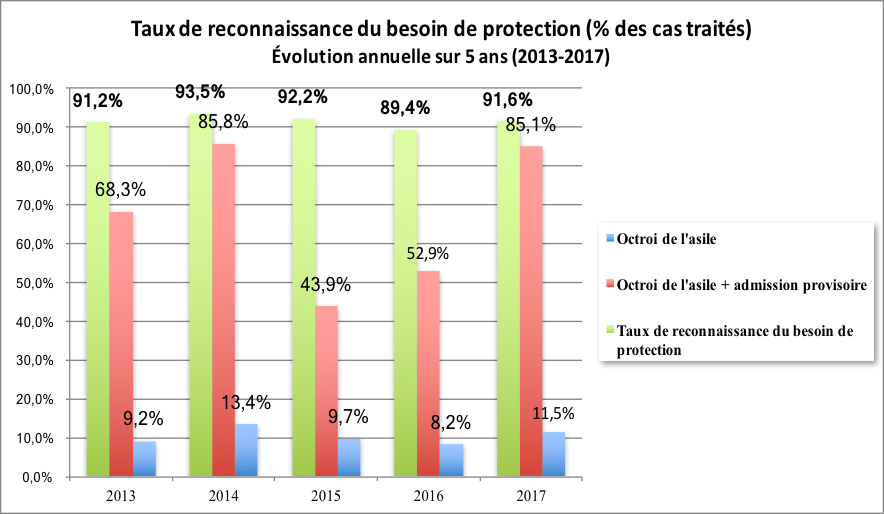
Regarding the protection rate and the statistical reasoning for evaluating the protection rate, see our page Swiss Statistics and decryption: In Switzerland, what recognition of the need for protection in 2017?
JOYCE BITZBERGER