
European comparison
Number of requests in Europe
It is important to keep a global perspective on migratory flows in mind. As we have seen, the number of asylum applications is influenced by the global geopolitical context. An increase in applications is therefore the result of complex factors. These are structural as well as individual. It is therefore illusory to want to explain them by a single factor, such as a deterrent asylum policy.Evolution of demands).
According to Eurostat data, 648,700 asylum applications were filed in 2021 (EU/EFTA). This figure has therefore significantly decreased since 2015, when the number of applications was 1,393,930 people.
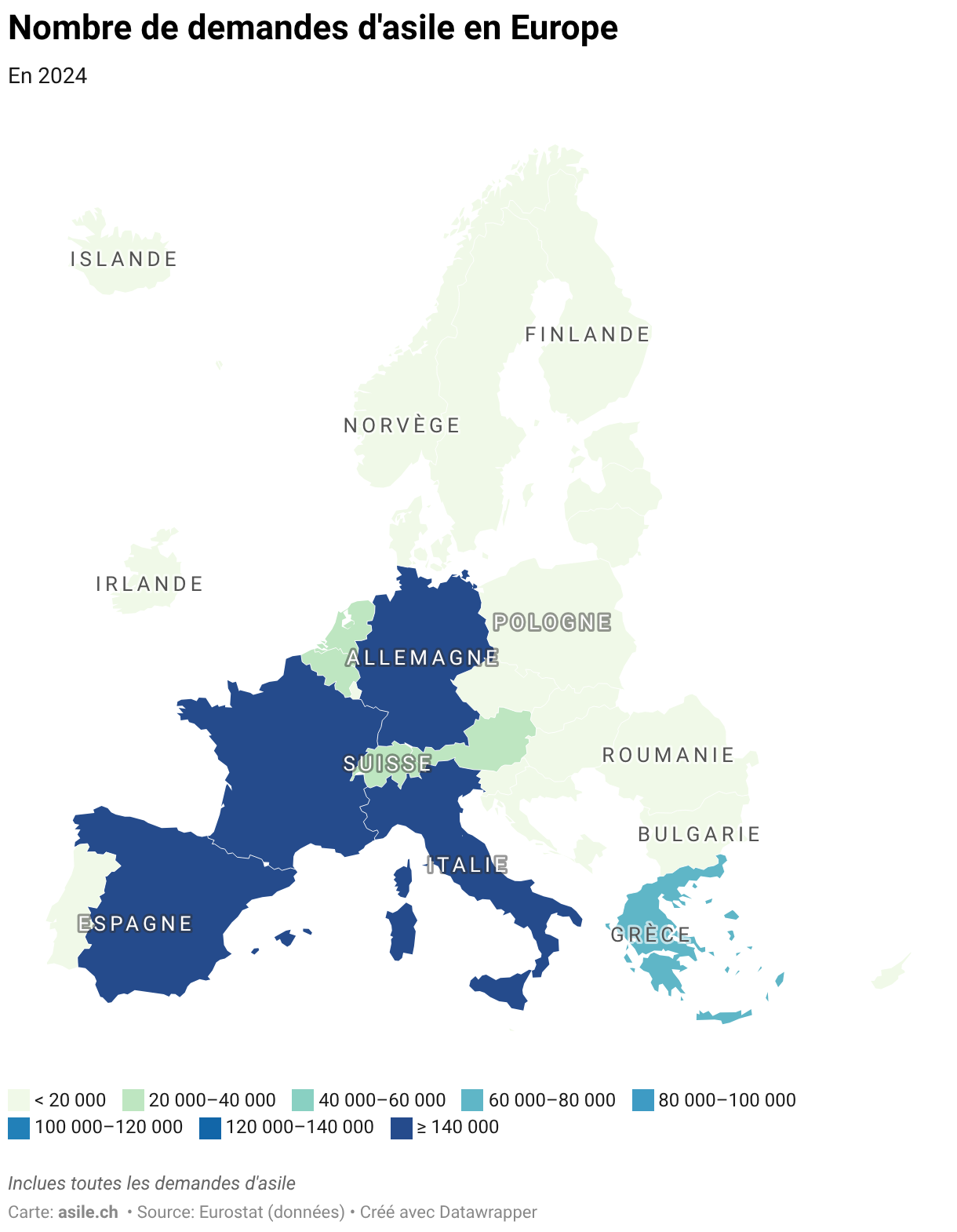

Evolution of protection requests in Europe
Despite regional disparities, we observe similar trends to Switzerland in the evolution of asylum applications in Europe: their numbers vary from year to year, but these fluctuations are often observed in a majority of host countries. Through three visualizations below, we analyze the historical evolution of international protection applications in Europe and Switzerland's place in this European perspective.

The graph above shows a certain stability in the number of asylum applications in the 2000s, followed by an increase in applications around 2015. The magnitude of the increase in applications can vary from country to country. We observe a very significant peak in Germany, Sweden, Hungary, and Italy that year. The number of applications has since declined and returned to the level of the early 2000s in most countries. In absolute terms, Switzerland records only minor fluctuations compared to other European countries. The raw number of asylum applications is not always significant in itself, particularly when seeking to assess the integration capacity of refugees into the host society. This number can therefore be calculated based on the country's population size (per 1,000 inhabitants) as above. Or by other factors such as wealth (GDP), unemployment rate, or country size.
See about this simulation proposed by the nccr – on the move project which allows you to select the desired factor.
Switzerland is located in Central Europe.
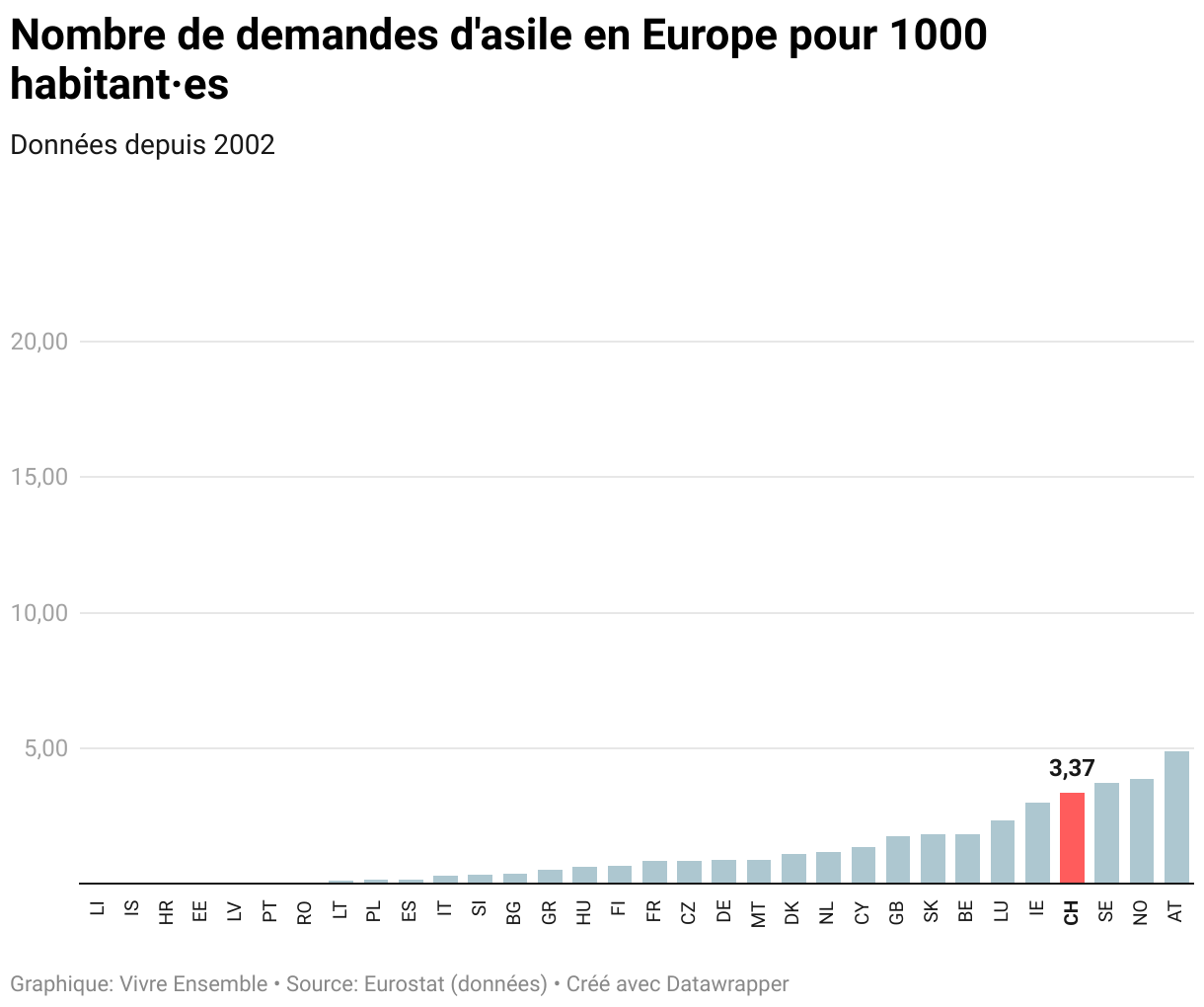
This graph allows you to visualize Switzerland's position in comparison to other European countries. Until 2014, it ranked highest among host countries relative to its population size. Since then, Switzerland has fallen behind Germany, Sweden, and France. It is worth noting that Greece, Cyprus, Malta, and Luxembourg continue to be among the countries receiving the most asylum applications.
Notes on statistical data: Due to a lack of data for either the number of asylum applications or the population for certain countries and regions, the graph contains missing information (France, EU-27). For the representation of data at the European Union level, we use the aggregated EU-27 (2007-2013) level, which includes all countries that were part of the EU between 2007 and 2013 (excluding Croatia but including the United Kingdom).