
Reflection | Asylum and Humor
«Humor, that irreducible expression of ethics.» Daniel Pennac
To the Happiness of Ogres, 1985, p. 176.
As an introduction
The title of this article may seem surprising: asylum and humor, isn't that a rather unusual pairing? When we consider all the distressing experiences of migrants in their countries of origin and on their journeys of exile, all the rejections faced by asylum seekers and refugees in their host countries, all the obstacles, administrative or otherwise, that those who support and assist them struggle with, is there really anything to joke about? Feelings of powerlessness, resignation, revolt, and bitterness are more likely to set in. And yet, perhaps humor could allow us to distance ourselves from these heavy feelings, which risk demobilizing and crushing us, by constantly confronting us with the tragic.
From someone who has a sense of humor, we say they are witty, and their jokes are called witticisms. It could therefore be that there is something in humor like a spirit, a breath that carries us, in spite of everything that weighs us down. A German thinker, Otto Julius Bierbaum, said: «Humor is when you laugh in spite of everything.» Humor would therefore be like a spiritual force of resistance, urgent today in the field of asylum! But laughter, humor can also be very ambiguous: one can do a lot of harm by laughing, as is the case with jeers, mockery, cynical laughter. We must therefore take a small philosophical detour to distinguish between two very different views on humor, before we can make it fruitful for asylum.
Laughter of derision: a first look
«Laughter is unique to man,» this now-famous phrase originates from a physiological observation by Aristotle: he believed he had noticed that only the human diaphragm had the capacity for sudden spasms, which caused humans to laugh. The phrase later became a humanist principle, notably for Rabelais in the 16th century, who used it as a weapon against his main enemies, whom he called «agelasts» (from Greek: those who do not laugh). Aren't there many agelasts in immigration offices...? However, a somewhat unfortunate idea took root: that there is a kind of superiority in laughter. Aristotle himself, and later the English philosopher Hobbes, and especially Henri Bergson, in his famous book on laughter, defined it as a «social reprimand»: laughter is about disqualifying what is base, small, or weak by ridiculing it. By laughing at it, one reinforces what is good, great, and strong. Thus, in Molière's comedies, we mock the miser, the hypocrite, the hypochondriac, etc. We are all familiar with this form of humor, by which we distance ourselves from others, from those who are different, by venting our frustrations at their expense: the foolishness of Belgians, the backwardness of German-speaking Swiss, etc. This venting can feel good because it "de-stresses" and relaxes. But since it comes at the expense of others, it lacks a certain spirituality...

Liberating Humor: A Second Look
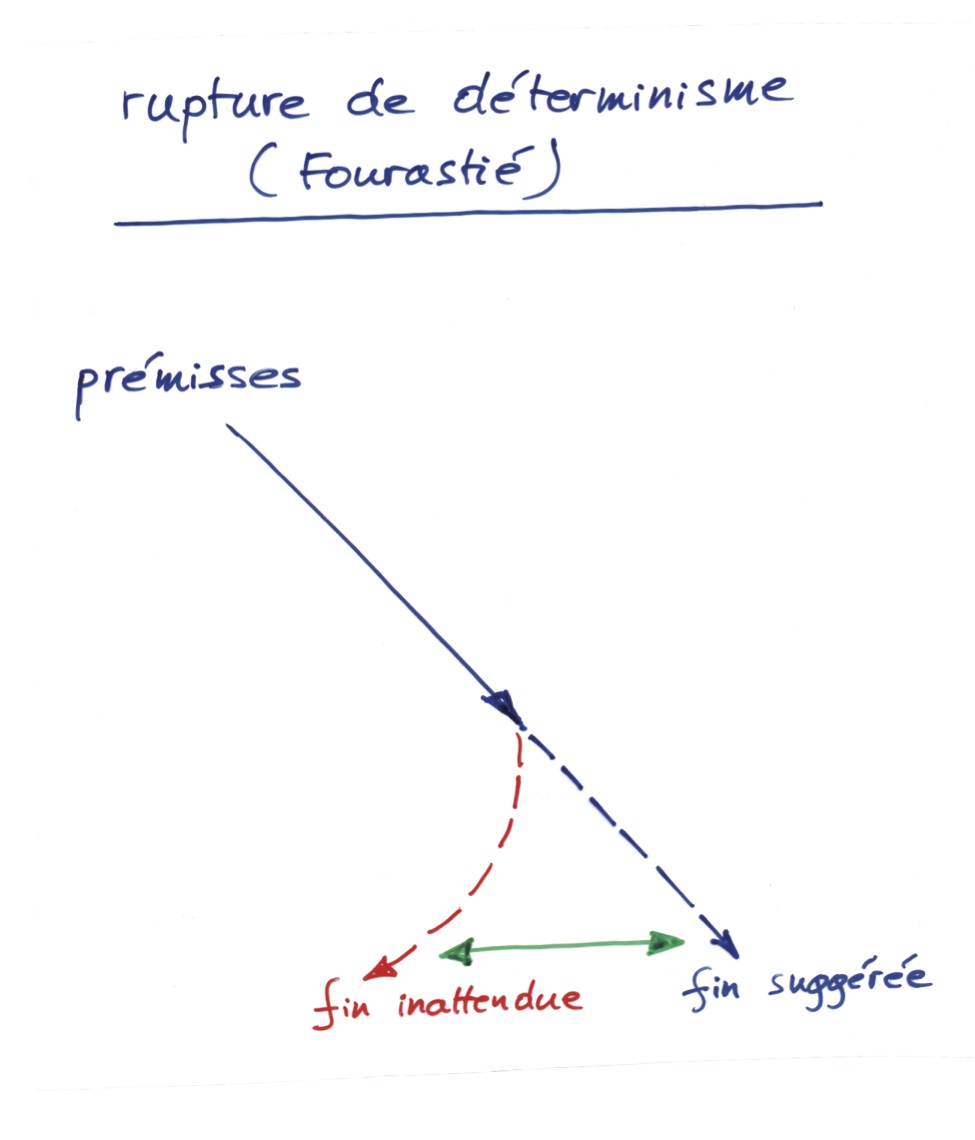
So it’s not enough to simply laugh to have a sense of humor: humor is first and foremost a mindset with which I approach things, a way of life. Here, I’d like to draw inspiration from two other philosophers. Arthur Koestler sees a single principle of creativity—which he calls «bisociation»—at work in three areas of human activity. After searching for a long time for a solution to his scientific problem, it was while taking a bath that Archimedes discovered that one can measure the volume of a complex object by submerging it in a liquid. Similarly, the poet solves his problem of description by using a metaphor that is incongruous in itself («Achilles is a lion,» even though he is a human like us). Humor works in the same way, by creating an unexpected collision between two frameworks (Oscar Wilde: «Read the Peerage; as fiction, I know of nothing better!»). Here is how Koestler graphically represents the bisociation of humor. Jean Fourastié expanded on Koestler’s idea by speaking of humor as a break from determinism: starting from certain premises, a funny story suggests a certain ending, but suddenly veers toward an unexpected ending, and the resulting surprise effect provokes laughter. From this, Fourastié derives a whole philosophy, a whole wisdom of life: when we are under pressure, we are trapped in a single way of thinking, determined by what obsesses us. Humor is a means of breaking this determinism. It teaches us to shift our perspective. It is thus a driving force for creativity in problem-solving, offering the possibility of approaching problems from different angles. This is what makes humor a force of spiritual resilience: an inner freedom that allows us to bounce back, with new resources, instead of despairing. To put it in the words of Friedrich Dürrenmatt: “Certainly, those who see the absurdity, the hopelessness of this world, may despair; yet this despair is not a consequence of this world but a response it offers to this world; another response would be not to despair—one’s decision, for example, to stand up to this world in which we often live like Gulliver among giants. […] It is always possible to show the courageous man.”
Asylum and humor
What about the field of asylum? In this difficult area, we are often trapped in single ways of thinking, often victims of determinism. We could therefore discover in humor the possibility of breaking this determinism, of changing perspective. Those responsible for Living together have always practiced this method, offering readers humorous drawings to create distance from the weight of tragedy, the despair of administrative dead ends, and the crushing force of prejudice. May they be encouraged to persevere on this path! Humor is a space in which one can express fatigue, anger, and powerlessness, but also draw strength from hopes and resources. It allows us to laugh, but sometimes also to cry, in order to find new energy. Let us briefly recall three liberating functions of humor, without claiming to be exhaustive:
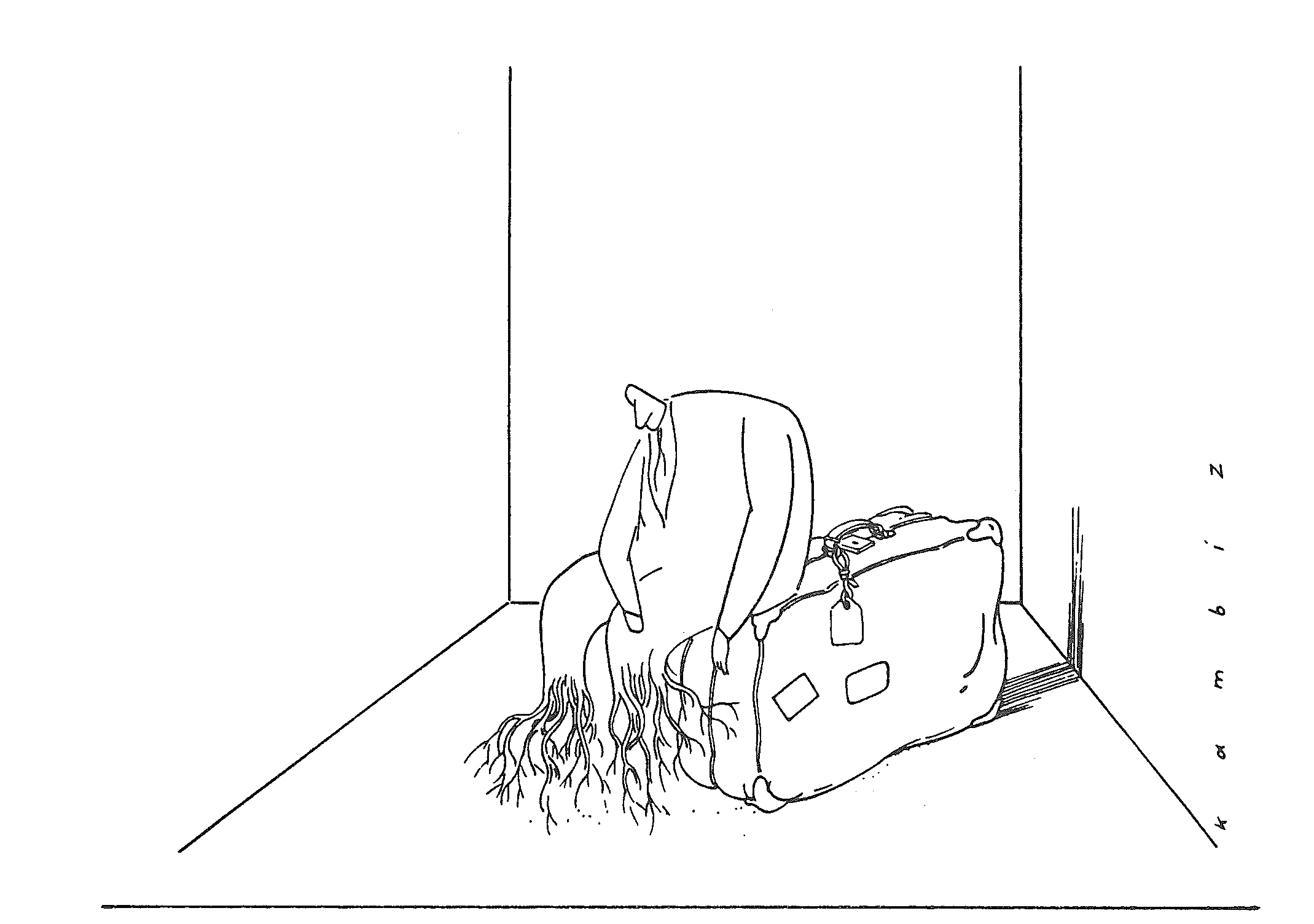
a) Society sometimes tends to want to ignore the reality of asylum, so as not to have to confront it. Humor can challenge this «blindness» by forcefully reminding us of this reality, as in this drawing by Kambiz, which conveys the uprooting of the exile through a beautiful bisociation in Koestler's sense: a tree-man whose roots have been torn out.
b) Anchored by certain convictions, we then adopt peremptory, ideological positions, without realizing how much they can distort the perception of problems. From this perspective, humor has a revealing function: it exposes simplifications and contradictions, as in this threshold experience: the doormat welcomes visitors, but the door is completely walled up…

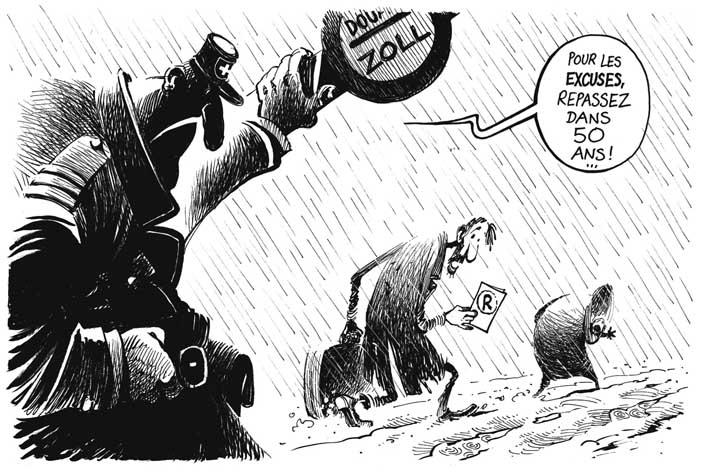
c) Humans struggle to learn from their history, and experiences of exile and refuge are repeated. Humor critically appeals to our failing memory by creating collisions between various historical situations, as in this drawing by Chappatte!
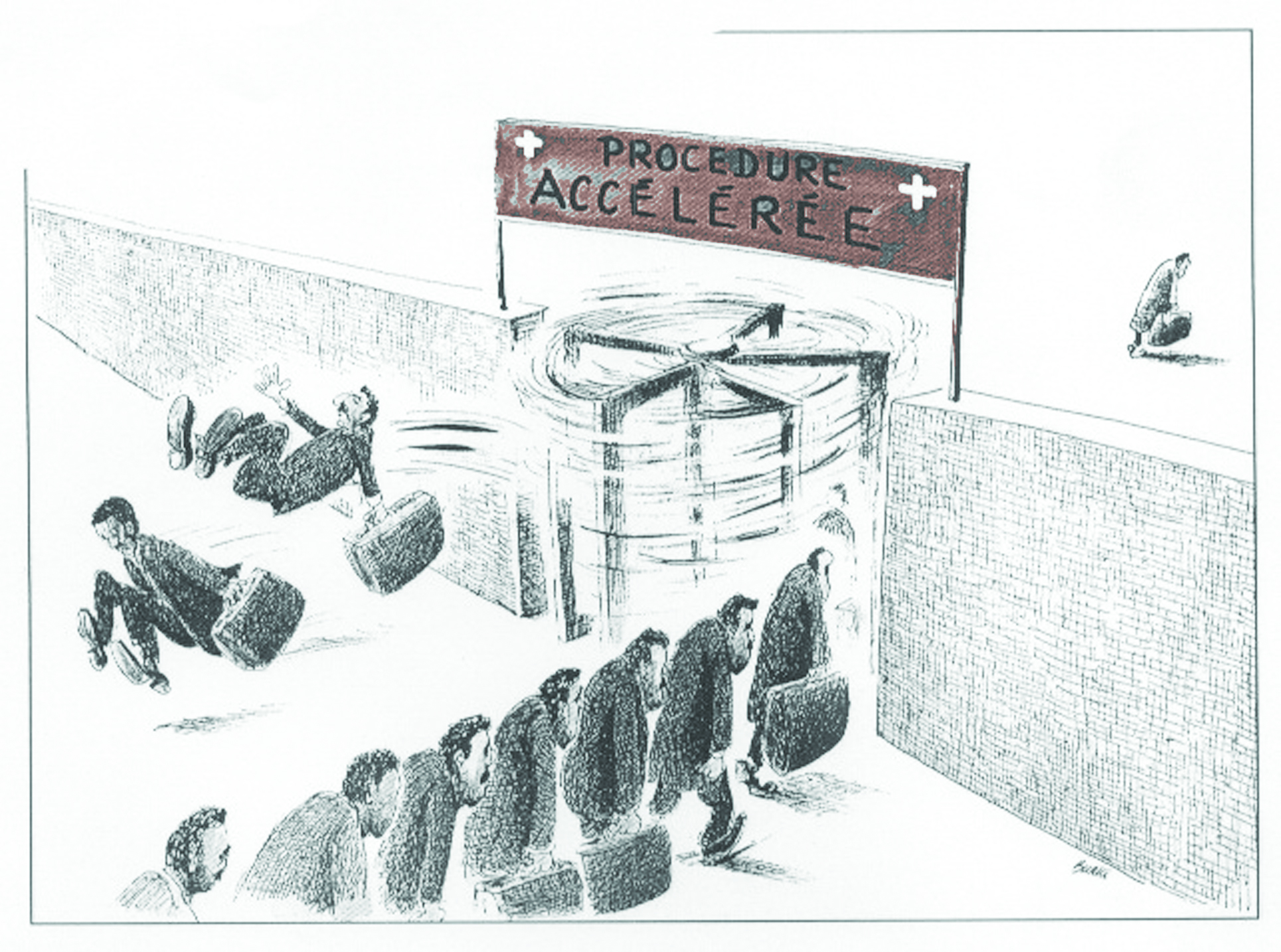
d) Humor also serves a critical function in relation to certain persistent obsessions in how problems are perceived or in the search for adequate solutions. For many years, people have wondered what distinguishes a real refugee from a false one – let's make it a competition...! Or, again and again: how to speed up the asylum procedure? Would a revolving door do the trick?
In conclusion
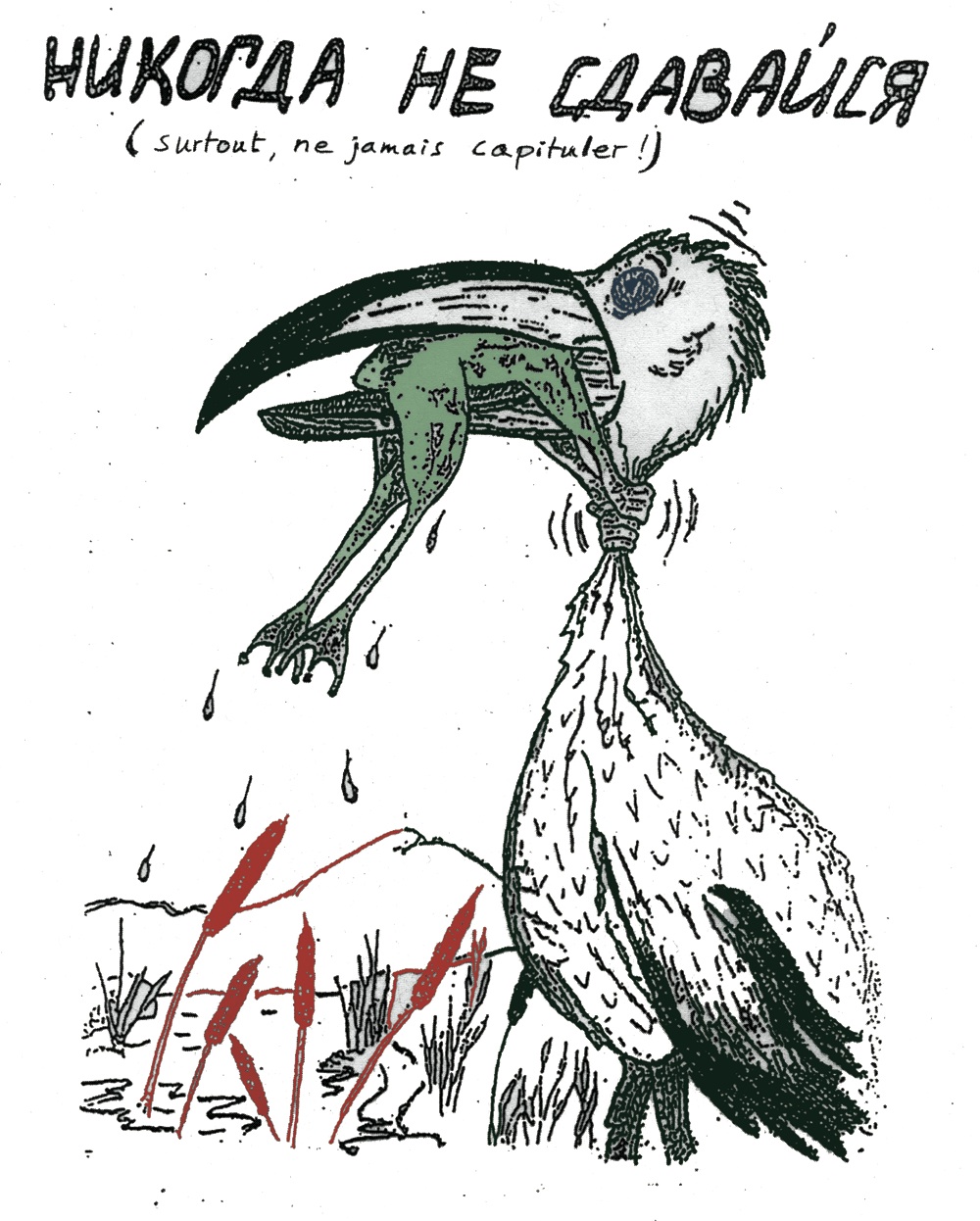
My conclusion can be summed up by an anonymous Russian drawing. The frog is in a desperate situation: it's already half-eaten by the bird, but with its front paws, it has grabbed the bird by the throat, thus preventing it from swallowing it! «Above all, never give up!»
PIERRE BÜHLER
Pierre Bühler is a professor at the Faculty from theology at the University of Zurich. In 2010, we published a reflection by the same author on the occasion of the 25th anniversary of Vivre Ensemble. It is available on our website asile.ch: Pierre Bühler, «Ethical Criteria for Resistance,» Vivre Ensemble, no. 130 / December 2010.